
I’ve spent thirty years building custom homes, and I’ve noticed the same pattern almost every time a project goes sideways. It’s rarely bad luck.
More often, the trouble started months earlier, before the first shovel ever hit the ground. The wrong builder was chosen. The budget was based on incomplete numbers. The design moved too far ahead without construction input. Or expectations were never clearly defined in the first place.
This is the guide I wish every client would read before we sit down for that first meeting.
Pick Three Out of Four
I think about a couple I’ll call Bill and Susan.
They once collected six estimates from six flooring companies to refinish their hardwood floors. They chose the lowest bid. About a month later, the neighbors could hear them yelling at the crew that showed up.
They expected a beautiful, high-quality floor. What they got was exactly what they had paid for.
Custom home building works much the same way.
There are four things most homeowners want from a builder:
- Quality
- Speed
- Service
- Price
In my experience, you can realistically expect a builder to deliver three of those four very well. Almost nobody delivers all four.
When someone promises exceptional quality, fast construction, great service, and the lowest price, I would ask some hard questions. Something usually has to give.
Before interviewing builders, decide which three matter most to you.
If keeping the price as low as possible is your top priority, expect compromises somewhere else. If quality is non-negotiable, expect to pay a fair price for the people, materials, planning, and supervision required to achieve it.
There isn’t a right answer for everyone. The important part is knowing your own priorities before the project begins. Otherwise, even a good builder may disappoint you simply because you were measuring success differently.
Choose Your Builder Before You Choose Your Architect
This is probably the advice I give more often than anything else, and it runs against the way many people naturally approach a custom home.
They buy land, hire an architect, spend months developing a beautiful design, and only then start asking builders what it will cost.
That sequence can create an expensive problem.
A beautiful set of architectural drawings created without builder input can become a beautiful home you cannot afford to build.
That doesn’t mean the architect did anything wrong. Architects are designing around your goals, your site, and the vision you give them. But somebody also needs to evaluate those decisions against real construction costs while the design is still flexible.
That is why I prefer bringing the builder into the process early.
With a builder-led design-build approach, the people responsible for estimating and constructing the home are involved while the plans are still taking shape. Materials, structural decisions, site conditions, engineering requirements, and construction methods can be discussed before they become expensive lines on a finished drawing.
We explain this further in our guide to what it actually costs to build a new home.
The goal isn’t to let the budget dictate every design decision. It’s to make sure you understand the cost of those decisions while you still have choices.
Know What Things Really Cost, Not the Internet’s Version
Price per square foot gets more attention than almost any other number in custom home building.
It’s also one of the easiest numbers to misunderstand.
People often compare custom construction costs with resale homes, production homes, or numbers they find online. Those comparisons usually leave out important context.
A custom home isn’t being designed around what will appeal to the broadest possible resale market. It’s being designed around your site, your priorities, your architecture, your finishes, and the way you want to live.
Even two custom homes of the same size can have dramatically different costs.
Then there is the way builders calculate price per square foot.
One builder may include site work, landscaping, driveways, porches, retaining walls, and other exterior improvements. Another may leave several of those items outside the calculation.
On paper, the second builder suddenly looks much cheaper.
That doesn’t mean the project is cheaper.
We go into this in more detail in our article about whether cost per square foot includes outdoor living space.
When comparing builders, don’t stop at:
“What is your price per square foot?”
Ask:
“What exactly is included in that number, and what isn’t?”
That question will tell you far more.
Build a Realistic Budget, Not a Fixed Number
People usually begin a custom home project logically.
They create a budget. They define what they need. They make spreadsheets. They think carefully about square footage, materials, rooms, and priorities.
Then construction begins.
Suddenly, those decisions become personal.
You’re standing inside the future kitchen. You’re looking at the view from the living room. You’re choosing the flooring you’ll walk on every morning. You can actually see what another three feet of space might do for a room.
People start making decisions differently when the home becomes real.
I’ve seen that happen over and over again, which is why I encourage clients to think about their construction budget as a range instead of one immovable number.
A realistic range gives you room to make decisions during the process.
Maybe you decide the expensive countertop isn’t worth it.
Maybe you realize the screened porch matters more than you expected.
Maybe you want to invest more in windows, cabinetry, or another part of the house you interact with every day.
A budget range gives those decisions somewhere to go.
A hard number leaves very little room when your priorities change.
The point isn’t to encourage overspending. It’s to recognize that a custom home develops as you move through the process, and your budget should account for that reality.
Understand Your Timeline, Including the Weather
Construction schedules look very orderly on paper.
Weather does not.
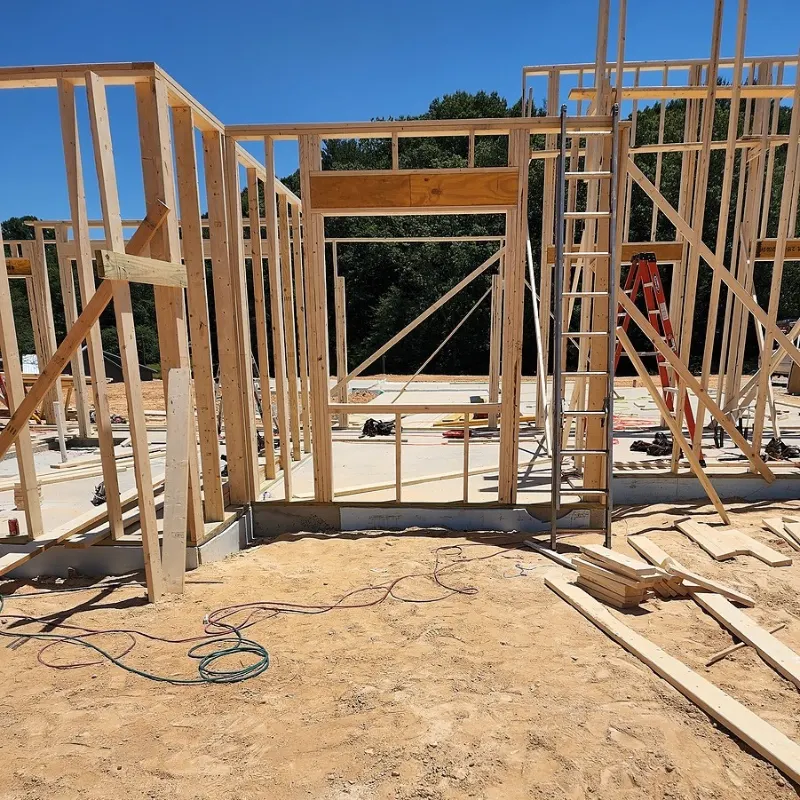
Here in Western North Carolina, people sometimes assume winter temperatures are the biggest threat to a building schedule. In our experience, rain and the humidity that follows it can cause far more disruption.
We’ve had projects where weather affected excavation, foundations, framing, drying conditions, and site access. On one project, a hurricane even washed out fully formed footings.
You cannot eliminate that unpredictability.
What you can do is plan for it.
Good construction scheduling isn’t about pretending every week will go exactly as planned. It’s about creating systems that can absorb delays without allowing the entire project to unravel.
We explain more about local seasonal conditions in our guide to the best time to build in Western North Carolina.
When talking with a builder about timeline, ask how they account for weather, inspections, material lead times, subcontractor scheduling, and other variables.
The answer matters more than the promised completion date.
Watch for the Costs That Usually Catch People Off Guard
Hidden costs rarely arrive as one giant surprise.
Usually, they come from a series of smaller omissions.
A permit wasn’t included.
A survey was assumed to be somebody else’s responsibility.
General conditions weren’t clearly explained.
Design fees sat outside the construction budget.
The driveway, retaining wall, landscaping, or another site-related scope was treated separately.
Each number may look manageable by itself. Add them together and the budget can change quickly.
That is one reason homeowners should understand the difference between construction pricing methods. We explain part of that in our article on markup versus margin and what those numbers actually mean to a client.
Other common cost problems include:
- Change orders made without a clear approval process
- Finish upgrades chosen late in construction
- Site conditions such as rock, poor soil, or drainage problems
- Allowances that were unrealistically low from the beginning
- Work that homeowners assumed was included but never appeared in the specifications
A builder cannot predict every condition hidden beneath the ground.
But good planning can reduce a lot of the uncertainty.
Early surveys, site evaluation, detailed specifications, realistic allowances, and clear documentation all help.
Most importantly, you want a builder who is willing to tell you what is not included in the price.
Sometimes that conversation is more valuable than hearing everything that is included.
Protect Yourself Before You Sign a Contract
You can learn a lot about a builder before construction ever begins.
One warning sign is a builder who says yes every time you ask whether something is included.
It cannot all be included.
If every answer is yes, you may not have reached the details yet.
You should also be cautious if a builder can only provide one or two references, particularly when those references feel unusually polished or carefully selected.
Ask for a broader picture of their work.
Pressure is another concern.
Building a custom home is a major financial decision. You should have enough time to read the agreement, understand the specifications, ask questions, and compare what you are actually receiving.
Before signing, I would also recommend that homeowners:
- Verify the builder’s license with the appropriate state licensing board
- Confirm that their insurance is current
- Check for liens or other issues that may deserve further investigation
- Speak with previous clients
- Review the construction specifications carefully
- Understand the change order process
- Identify allowances and exclusions
- Clarify who is responsible for permits, surveys, engineering, site work, and other related costs
Pay close attention to vague language.
“Premium finishes” sounds good.
It doesn’t tell you much.
Specific materials, brands, allowances, quantities, and scopes give both sides something concrete to work from. Vagueness creates room for disagreements later.
I wrote about this idea in our article on the four types of contractors. The builder you want is what I call a Type 4 contractor: someone whose promises are backed by repeatable systems, documentation, accountability, and a real process.
Anyone can promise a good experience.
You want to see how they actually create one.
Ask How Decisions and Changes Will Be Handled
Custom homes involve decisions. Lots of them.
Some happen before construction starts. Others happen after walls go up and you can finally understand the space in three dimensions.
The problem isn’t that changes happen.
The problem is when nobody has agreed on how changes will be handled.
Before you sign, find out what happens when you request something outside the original scope.
Who prepares the price?
Do you approve it before the work happens?
Does the change affect the schedule?
How is it documented?
Will you be able to see the cumulative impact of all your changes as the project progresses?
Those questions sound administrative until you are ten months into construction and trying to remember why the budget moved.
A good change order system protects the homeowner and the builder. Everyone knows what was requested, what it costs, and what happens next.
Pay Attention to the Site Before Falling in Love With the House Plan
The house gets most of the attention, but the land can change almost everything.
Slope, drainage, access, soil conditions, rock, utilities, retaining requirements, septic systems, and driveway placement can all affect what the home costs and how it should be designed.
This is especially important in Western North Carolina, where mountain properties can look incredible while presenting complicated construction conditions.
I would much rather evaluate those issues before a client becomes emotionally attached to a particular floor plan.
Sometimes a site supports the original idea beautifully.
Sometimes the smarter decision is to rotate the house, change the foundation, reduce excavation, move the driveway, or rethink part of the design.
Those changes are much easier to make early.
Once engineering and architectural plans are complete, every adjustment becomes more expensive.
Don’t Treat the Lowest Bid as the Best Bid
The lowest proposal is easy to understand.
The best value takes more work.
When two construction bids are significantly different, something usually explains the gap.
Maybe one builder included more.
Maybe one used higher allowances.
Maybe one carries more supervision.
Maybe one has more complete insurance, stronger project management, or better subcontractors.
Maybe the cheaper bid genuinely found efficiencies.
Or maybe something important is simply missing.
The only way to know is to compare the actual scopes.
I would rather see a homeowner choose a builder based on clarity, competence, fit, and value than choose based on one number at the bottom of a proposal.
The initial price matters.
The final price, construction experience, quality of the home, and what happens after move-in matter too.
The Resource I Wrote for People Preparing to Build
Everything in this article is the short version.
I wrote an entire book, Building a Quality Custom Home: What You Need to Know, because these decisions deserve more than a few paragraphs.
It’s also the same book we require our own clients to read before we break ground together.
If you are seriously considering building a custom home, read it before you sign a construction agreement. The decisions you make before construction begins will affect almost everything that follows.
If you’d like to talk through your own project, reach out to Living Stone Design + Build. We’ll walk through the site, design, budget, timing, and construction process with you and give you the same straightforward answers we’ve given clients for thirty years.